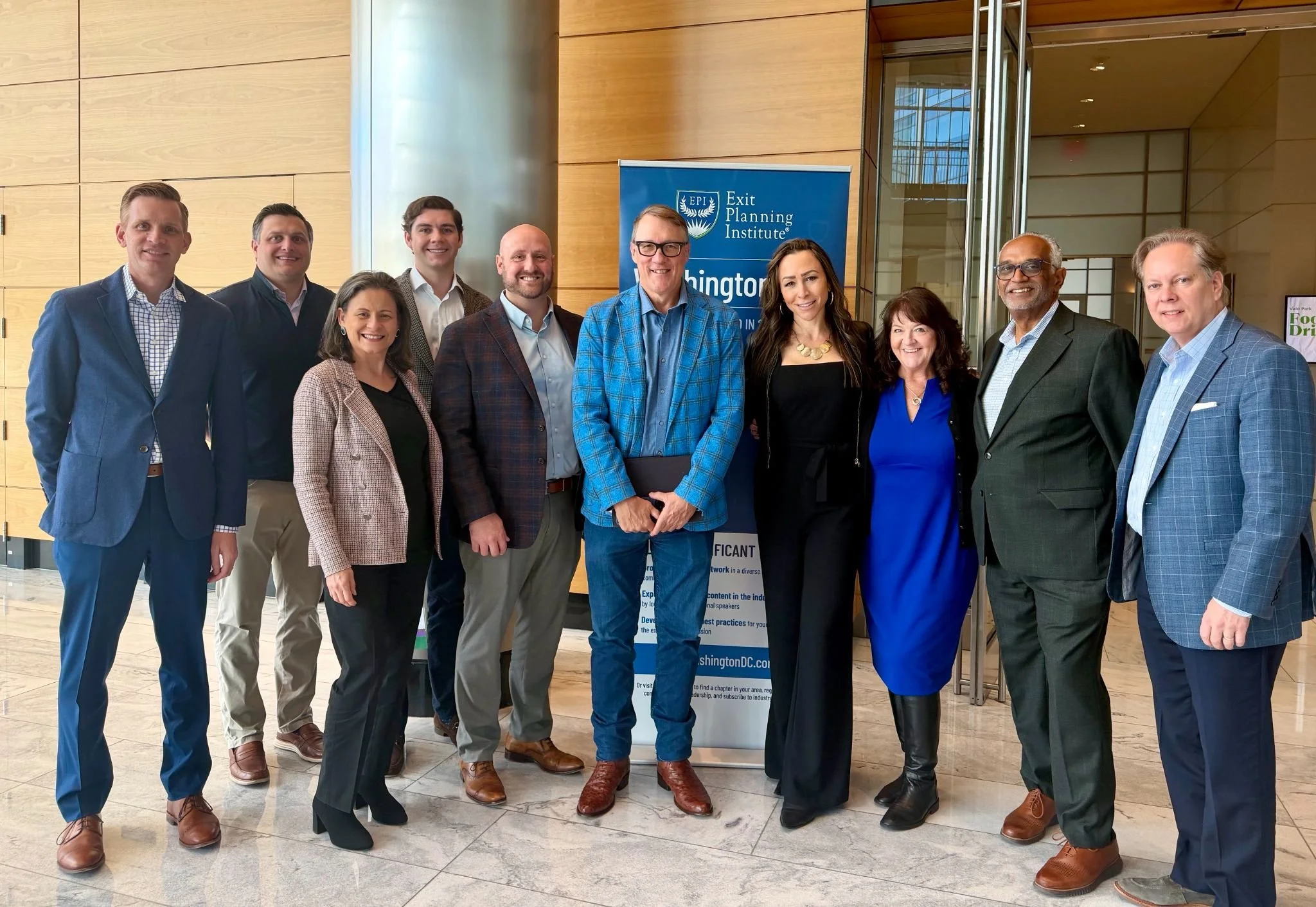
Our latest event for the DC chapter of the Exit Planning Institute® featured Renee Russo, a Value Growth Advisor, former EOS implementer, CEPA®, Former EOS Implementer®, and member of the Exit Planning Institute Thought Leadership Council.
She dove into how owners and their advisors should be using a business operating system like EOS (Entrepreneurial Operating System) or Scaling Up to guide their implementation of the Value Acceleration Methodology® (VAM). This methodology moves owners through three gates: Discover, where they assess their business’s value and personal goals; Prepare, where they close the gaps through 90-day sprints; and Decide, where they choose whether to exit or keep growing.
Value acceleration engagements, Renee argues, tend to stall right after the Discover gate. Pointing out what needs to change is the easy part. The advisor may craft a perfectly polished action plan, the owner then sets it on their desk, gets pulled back into the daily whirlwind of running the business, and nothing changes.
Renee offered a staggering statistic: up to 80% of business value lies within intangible capital (social, human, structural, and customer). She candidly states that without a business operating system, that value might never be unlocked. By the way, “business operating system” doesn't refer to software; it’s a small set of tools and disciplines that point everyone's energy toward a future the whole team understands. “Value creation is simply good leadership,” says Renee, and the business operating system is the backbone to it all.
How It Runs
Vision alignment: A three-year bird’s eye view tied to the owner's goals, aimed at fostering a business that is valuable, attractive and transferable.
People: The right people in the right seats so that the business can run smoothly without every decision needing to pass through the owner. The team needs to consistently gauge the extent to which the business can run independently.
Data: Using scorecards and KPIs to track progress weekly, monthly, quarterly, and annually to create structure and verify performance.
90-day rocks: Top priorities a business commits to finishing in the next quarter. These are delegated across the leadership team so the owner doesn’t have to manage them all, and progress is diligently tracked through weekly meetings.
Process: Documented, followed, and laser focused on the customer.
Meetings: A steady cadence where issues are solved quickly and team circles remain closely connected.
The goal isn't rigidity; it’s discipline and accountability that are necessary for securing a great future. As Renee eloquently put it, you "systemize all the predictable elements of the work, so you can humanize the exceptional." Repeatable processes free owners from administrative minutiae and constant firefighting, allowing them to unlock wealth and focus on what they love. It also leads to optionality and creates a self-managing company that can transfer with confidence.
When To Bring In The Engine
Renee’s talk made a clear case for making the operating system the first priority of the Prepare gate. Owners might not be convinced at first. Renee points to the irony of this, noting that owners are often reluctant to pay a professional to put an operating system in place, but “they'll leave $40 million of enterprise value on the line." Ultimately, the value gap – the difference between what a business is worth today and what it could be worth if it reached best-in-class level – speaks for itself.
Renee’s own client is a great example of what happens when an owner makes that investment. He first came to her asking for help selling his company. Two years ago he tested the market at roughly a 4.5x multiple and fell flat. Since then, with an operating system running the business, he’s grown from just under $13M to around $50M, and his multiple range has climbed to 7–8x. He now chairs the board while his team runs the company, and he’s more often on a fishing boat than in the office. He no longer needs to sell, but he has the option.
The takeaway
Renee’s formula is simple: financial advisor + business coach = value acceleration. The plan shows where the business needs to go, and an engine that runs every 90 days is what gets it there. As Renee put it, “when you help your clients build a self-managing company, you can set them free.”
At TreeFork, we see exit planning the same way. It isn’t about scrambling to sell to the first suitor or waiting until burnout forces a decision. It’s about building an attractive, scalable, and resilient enough business so that the next chapter becomes a choice: sell, transfer it to the next generation, or stay on and enjoy what you’ve built.
Written By: