
GovCon Outlook 2026: Opportunity in the Midst of Organized Chaos
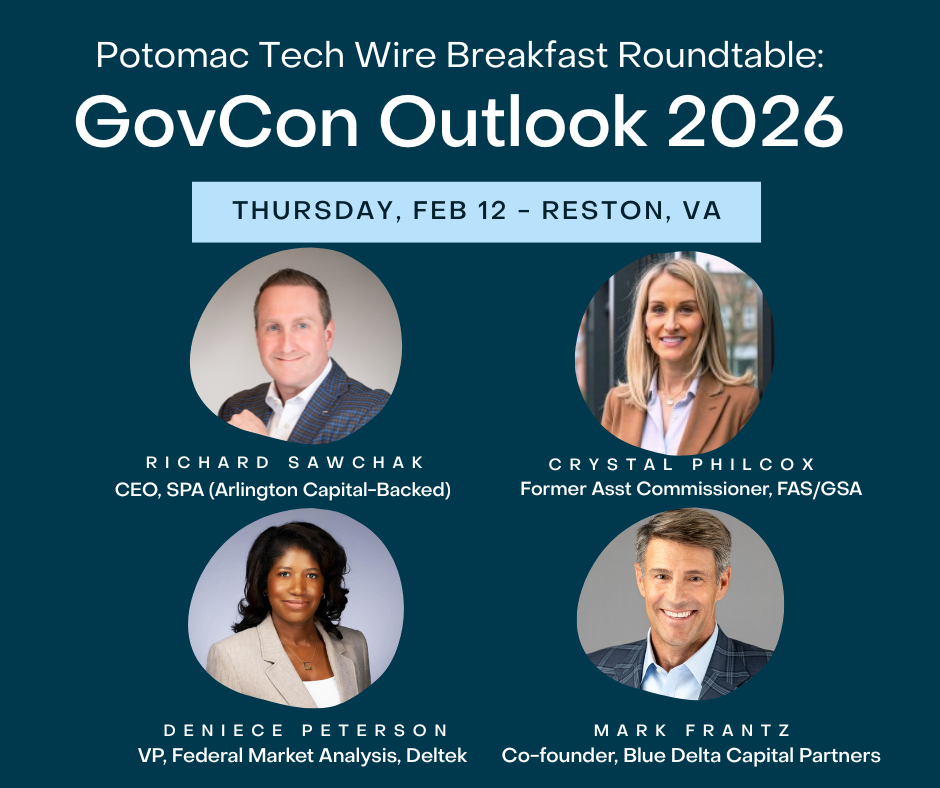
A four-person panel – bringing together perspectives from national security-focused government contracting, federal acquisition leadership, market/budget intelligence, and venture capital – laid out a clear theme for 2026 in GovCon & defense tech operations. Opportunity is real, but only for companies that can navigate rapid change, policy uncertainty, and shifting expectations.
This executive-level conversation included the following panelists:
Richard Sawchak, CEO of Systems Planning and Analysis
Crystal Philcox, former Assistant Commissioner for Enterprise Strategy Management in GSA’s Federal Acquisition Service
Deniece Peterson, VP of Federal Market Analysis at Deltek
Mark Frantz, Co-Founder of Blue Delta Capital Partners
Where Opportunities Lie
Crystal emphasized differentiation: contractors must position themselves as innovative, “scrappy” partners who drive continuous improvement, demonstrate cost savings, and avoid vendor lock-in. In her view, the winners will be those who communicate innovation and long-term strategic impact, not just capability lists.
Deniece emphasized that defense and national security spending remain key areas of growth and attention but are also facing intense scrutiny.
Richard argued that the current industry favors companies that are outcomes-based and have built for opportunity far in advance. He emphasized that in this “market of productivity,” success depends on knowing your metrics, shaping work early, and avoiding a late-stage posture of waiting for RFPs and differentiating solely on price.
Mark Frantz noted that for the first time in a while, there is a real budget to execute against which the broader ecosystem will be able to take advantage of.
Biggest 2026 Risk: Consolidation & Chaos
Contract consolidation was highlighted as a central risk. Crystal warned that a push to government live contracts could shrink the industrial base and reshape which companies thrive and which ones fall behind. Deniece echoed this point, stating that companies are at risk if they haven’t yet positioned themselves to be on preferred contracts.
Richard stressed that this is not the beginning of the fiscal year from a government perspective and that agencies may not yet know where money will actually land. He asserted that this year’s risk is that “we get more of the same from last year,” characterizing last year’s budget process as “unorganized chaos” and this year as “organized chaos” which will thus require a mix of proactivity and reactivity. Finally, Mark noted that planning will be difficult amidst the current administration which is “chaotic somewhat by design.”
What’s Changed in the Last 18 Months?
The moderator then posed a unique question: “if an expert in the GovCon sector had been on a deserted island since October 2024 and just showed up today, what landscape would they be entering and what would they need to know?”
Deneice responded that the current environment would be “semi-recognizable” since policy and regulatory changes have come quickly and in high volume. However, in terms of actual spending, these rapid shifts seemed worse than they truly were. She also emphasized that this person would need to look at their long-standing relationships and potentially pivot to new agencies in light of the recent movement that has occurred in the workforce. Crystal highlighted the current administration’s lack of clear support for small businesses, the fact that AI expectations are now embedded in many RFPs, and the new deviations that have arisen from updated regulations which agencies are going to adopt at different times. Mark noted that the depth of the contracting core is gone, while Richard discussed the recent stock market upheaval and joked that the person in question should just “stay on the island . . . unless they enjoy chaos.”
How About Budgets?
On the budget outlook, Deniece said 2025 contracting activity was extremely healthy even if it didn’t seem that way. She pointed out that many proposed cuts have been rejected in recent appropriations, which is a reason to have some optimism. Nevertheless, it’s crucial to remain agile, relationship-focused, and “digging into customer intel to follow the money.”
Crystal was candid about FY2027: budgets aren’t getting passed on time, fights are likely, and a full-year continuing resolution may arise — meaning no new programs or projects can be implemented. Thus, she urged contractors to focus on extending current contracts.
AI and Threats: How Hype Meets Constraints
On national security threats and enabling technologies, Richard described a complex global threat landscape and said AI is no longer optional: if you’re not factoring it in, you’ve already lost. He emphasized secure, carefully constructed AI with humans operating in the middle, and flagged deepfakes, directed energy, and unmanned/smaller platforms as areas shaping future conflict capabilities.
Mark pushed back on the scale and speed assumptions. He questioned whether very large spending expansions can be financed or executed, pointing to deficits and capital-market limits. On AI, he agreed you need to be using it now—but argued practical constraints (including hallucinations) will slow the pace of real-world transformation relative to the hype.
Venture Capital & Private Equity
Mark described why investors have flooded into defense and GovTech – there’s a lot of money in the system, and traditional venture exits have been challenging – so capital is seeking a new market. But he warned that the math may not support the level of enthusiasm indefinitely, and he expects bumps, busted deals, and a messy year.
Richard predicted more leadership changes, portfolio reshaping, and a more active PE posture, while Mark countered that some owners are already exhausted and bringing companies to market—and that strategic buyers may still matter on a dollar-weighted basis.
Bottom Line: Be Outcomes-Driven, Focused on Relationships, and Operationally Nimble
Bringing together experts in data analysis, financing, government, and consulting, this panel was rich with insights. Here’s where the panelists’ opinions converged to form a practical 2026 playbook:
Build around outcomes, not promises or capability lists
Differentiate as a partner who reduces cost and avoids lock-in
Follow spending signals and manage pipeline/pricing discipline
Be AI-literate
Expect volatility – plan for bumps and broken assumptions
In this year of “organized chaos,” success will come down to one thing: adapting faster than the market shifts.
Written By: