
Our Exit Playbook: What Season One Taught Us About the Founder Experience
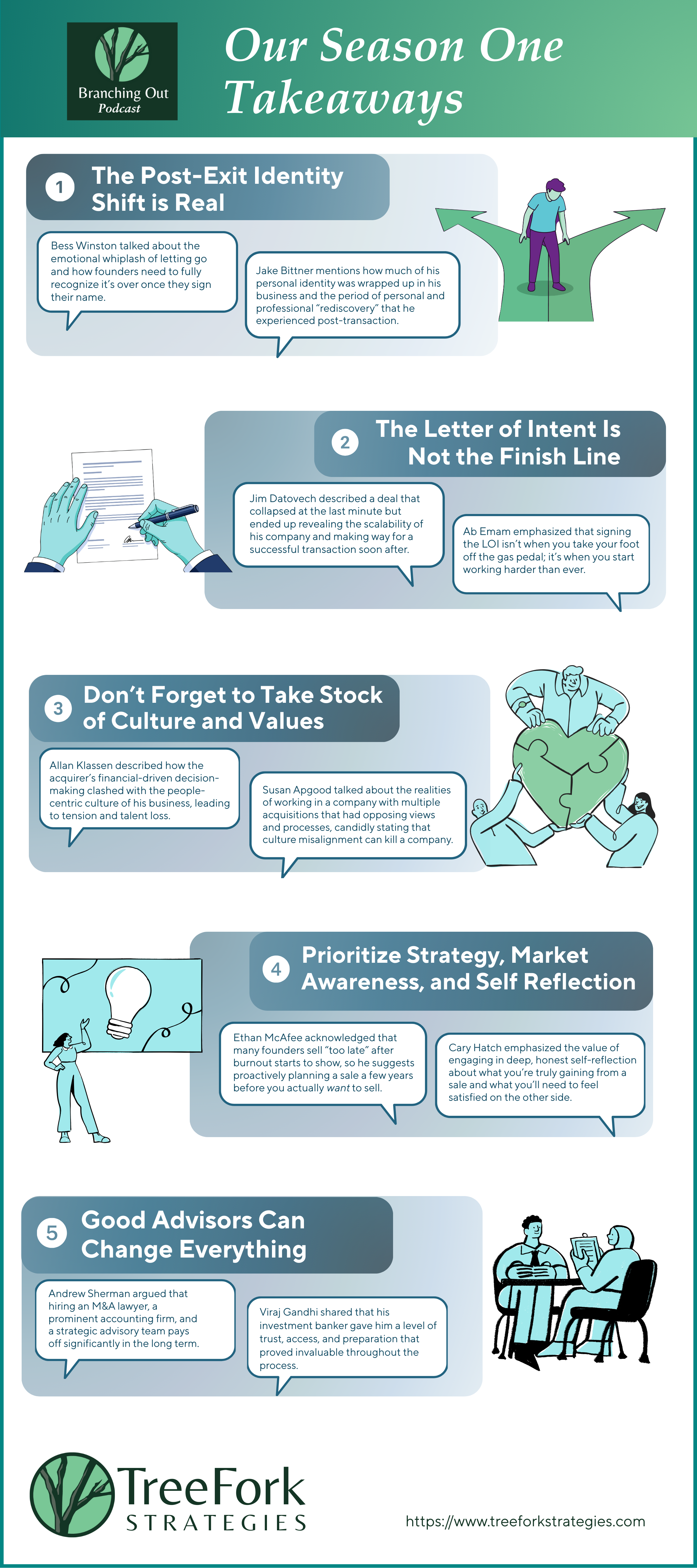
During our first season of the Branching Out podcast, we were honored to interview ten exceptional guests. Nine of them were founders / CEOs who drove their company to exit and one of which is a legal advisor with expertise in M&A transactions. While each exit experience is unique, we noticed that some common themes emerged in terms of what founders experienced and what they took away from their exit. Here are our key takeaways from season one:
1. The Post-Exit Identity Shift Is Real
Susan Apgood described going from CEO to being “super underutilized,” suddenly confined to a narrow role that didn’t reflect the leadership identity she had built over decades.
Bess Winston talked about the emotional whiplash of letting go and how founders need to fully recognize that it’s over once they sign their name.
Allan Klassen shared how the transaction process affected him emotionally and how he needed outside support to work through feeling like a “square peg in a round hole.”
Ab Emam shared a visceral moment when his acquirer took over control of the WDG domain names and he fully realized, “shoot, this is no longer me.”
Viraj Gandhi also discussed how the moment the deal was done was probably when he should have emotionally disconnected from the company and internally prepared for the changes that would take place. He then mentions the shift in lifestyle and mindset that occurs once you finally step away from the founder role.
Jake Bittner mentions how much of his personal identity was wrapped up in his business and how it took some time to detach from the company and enter a period of personal and professional “rediscovery.”
The Takeaway:
Selling a company is much more than a financial transaction; it’s one of the most significant milestones in a founder’s career. Because of this, founders should be aware of the emotional effects of letting go and how this shift can inform your next chapter.
2. Receiving a Letter of Intent Is Not the Finish Line
Ab Emam emphasized that signing the LOI isn’t when you take your foot off the gas pedal; it’s when you start working harder than ever before to impress your buyer and solidify the deal.
Jim Datovech talked about a deal that collapsed at the last minute but ended up revealing the scalability of his company and making way for a successful transaction outcome just months later.
Cary Hatch talked about walking away from multiple deals even after momentum had built, reinforcing that the excitement around closing a deal should never override your instincts about fit, alignment, and long-term impact.
The Takeaway:
If your performance dips during diligence, buyers notice. The months leading up to closing isn’t the time to coast – it’s the time to sprint.
3. Don’t Forget to Take Stock of Culture and Values
Allan Klassen described how the acquirer’s financial-driven decision-making clashed with a customer- and people-centric culture of his business, leading to significant tension and talent loss.
Susan Apgood talked about the realities of working in a company with multiple acquisitions that each possess opposing views and processes, candidly stating that culture misalignment can kill a company.
Bess Winston described how buyers tend to insist on cultural integration when it might in fact be beneficial to leave the acquisition alone.
Cary Hatch highlighted the importance of having your priorities and values in order and advocating for them when driving a sale process.
Andrew Sherman reinforced this from the advisor side, reminding founders that intangible value drivers such as culture and processes are often the “gold bars in the attic” that can substantially increase their value in the eyes of the buyer. However, sellers need to make sure that their company culture is ‘transferable’ – meaning that it’s not too distinct or too founder-dependent that it can’t be maintained post-sale.
Viraj Gandhi noted that cultural fit was a priority for him and he wished he spent more time during diligence observing how the acquiring company operates in the day-to-day in terms of leadership behavior, team collaboration during meetings, and office vibe.
The Takeaway:
Buyers may say culture matters—but founders must prove why it matters and how it drives value.
4. Preparing for Sale Involves a Mix of Business Strategy, Market Awareness, and Self Reflection
Ethan McAfee acknowledged that many founders sell “too late” after burnout already starts to show, so he suggests proactively planning a sale a few years before you actually want to sell.
Jim Datovech reminded listeners that markets, regulation, and capital cycles matter as much as personal readiness.
Andrew Sherman reinforced that being mentally “ready” to sell is one thing — true readiness comes from looking at your team members, operations, financials, and narrative through the eyes of the buyer and preparing accordingly.
Cary Hatch continually emphasized the importance of engaging in deep, honest self-reflection as a founder about what you’re truly gaining from a sale and what you’ll need to feel satisfied on the other side of it.
Ethan McAfee also emphasized that founders retain far more control over timing and outcomes when they prioritize profitability and disciplined burn over aggressive revenue growth. He argued that the less money you lose, the more freedom you have to choose when and how you sell.
The Takeaway:
The best exits happen when founders align market readiness with personal readiness, not just one or the other.
5. Good Advisors Can Change Everything
Ab Emam credited his banker with helping him move from 5–6x multiples to 9x.
Susan Apgood emphasized the importance of trusting your intuition when selecting a broker, since the wrong one can have a deeply negative impact.
Andrew Sherman argued that it’s not enough to have a regular lawyer or bookkeeper – hiring an M&A lawyer, a prominent accounting firm, and a strategic advisory team pays off significantly in the long term.
Viraj Gandhi shared that his investment banker gave him a level of trust, access, and preparation that proved invaluable throughout the process.
The Takeaway:
From investment bankers to lawyers to communications partners, it’s crucial to have the right team. Good advisors don’t just protect value – they also help founders spot and unlock the value they didn’t realize they had.
Additional Founder Takeaways
Beyond the major themes that surfaced, here are a few more lessons that are worth calling out on their own:
Jake Bittner emphasized the importance of learning to think like “deal people” well before a transaction is on the table.
Jim Datovech highlighted the long-term impact of financial discipline, noting that growth capital is expensive and that spending restraint pays off especially when market conditions shift.
Bess Winston reflected on the advice she received when she began the sale process, sharing that well-meaning voices can sometimes distract founders from their own instincts and priorities at critical decision points.
Allan Klassen stressed the importance of identifying and communicating non-negotiables early – particularly when selling to a larger, transaction-driven organization – so founders don’t lose clarity or compromise values under pressure.
Ethan McAfee knew that he wanted a clean break from his company post-sale to focus on the next chapter, so he intentionally made himself less central to the business by stepping down as CEO before selling.
The Big Picture
Across ten distinct guest reflections, it became clear that selling a company can test and shape your identity, leadership, patience, and self-awareness. And it almost always changes founders in ways they never could have expected.
Our goal for this season was to demystify the exit process, providing pragmatic advice and anecdotes meant to sharpen your strategy and calm your nerves whether you’re a founder who’s initiated the sale process or quietly wondering if it’s time.
We are looking forward to another season of insightful conversations, this time with guests from the worlds of buy-side M&A, investment banking, and venture capital to offer a multifaceted perspective of the exit process and insights for founders experiencing different types of inflection points. We hope you will continue to enjoy our programming!
Written by: