
Exit Strategy 101: An EPI DC Chapter Panel

The D.C. chapter of the Exit Planning Institute® was built on the premise that exit planning is not simply a transaction to execute at the end of a career; it is a purposeful strategy woven into how a business is built, led, and ultimately transferred. This philosophy became the center of a candid conversation about the three phases of EPI’s Value Acceleration Methodology – Discover, Prepare, and Decide – and highlighted some uncomfortable truths about the gap between founder expectations and how exits actually pan out. The chapter's recent panel event was moderated by Guillermo Birmingham and featured the following esteemed panelists:
Sara Evans, Professional Certified Coach for business transitions specializing in Industrial / Organizational Psychology, Founder & CEO of Sara G. Evans Career Consulting, LLC
Brian McDonald, Financial Advisor for transitioning business owners at Edward Jones
Corby Megorden, CEPA and Principal at Ennis Legacy Partners
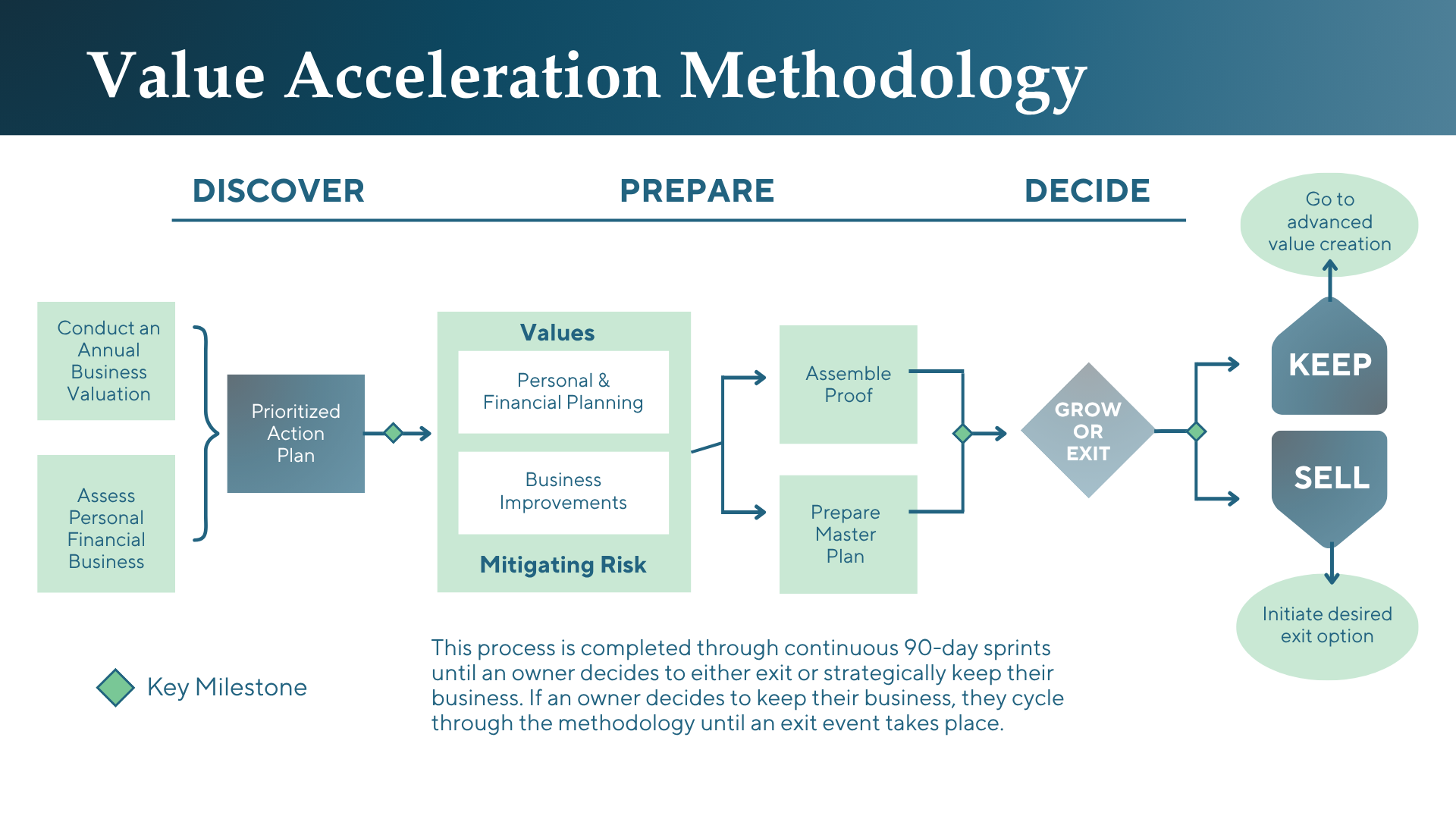
The Value Acceleration Methodology as outlined by the Exit Planning Institute®
1. Exit satisfaction is surprisingly rare
Sara said many founders fixate on the multiple without contemplating the deeply personal dimensions of a sale. If she is concerned that a founder is unclear about their personal vision and purpose outside of the business, she "talks about other clients who have had disappointing outcomes” . . . such as “people who are very depressed after being extremely rich, and sitting on their back deck saying ‘what have I done? I gave away what made me happy.’"
The discussion moved to a sobering statistic uncovered by EPI’s own research: 75% of business owners experience remorse within a year of selling. The remorse, Sara explained, typically stems from a loss of purpose, identity, or community, especially if a founder feels they’ve let down their team or if the acquiring company makes extensive changes post-sale.
Corby mentioned that when his team begins asking more personal questions, it tends to stall the process because “the fear factor of what’s next hinders actually taking steps.” Founders that do skip the vision work, he says, often end up profoundly regretting the sale.
Brian’s team at Edward Jones makes a consistent effort to ask personal questions upfront to uncover precisely what a founder wants their next chapter to look like. “We make sure that’s articulated so that everything that we’re doing on the planning side is to achieve that goal,” he said.
2. Exit planning is about being realistic and knowing your key value drivers
Guillermo asks Brian how often founders’ expectations realistically match valuation outcomes, to which Brian responds that "it seems that all the business owners that are clients of mine – whether they're a tech company in Indianapolis, a veterinary practice in Tennessee, or a tech company here in Sterling – thinks their business is worth $10 million dollars."
In the face of unrealistic expectations, his job, he explained, is to illuminate possibilities that owners may not have considered such as the catastrophic impact of an unexpected health event. He uses an analogy: everyone carries homeowners’ insurance because losing a house would be devastating, yet almost no one considers what might happen if that exact cost happened at the last stage before retirement. Having these candid conversations allows founders and their teams to react accordingly when unforeseen circumstances arise.
Corby then brings up a key point: “value drivers, key components of the health of the business, really affect what’s going to happen at any deal table.” The most critical value driver is owner dependency. He states that founders may “have their hands on the steering wheel and will not let go, which becomes a key factor in the value that is actually realized."
He then touches on the state of the current market, saying “With the silver tsunami coming, there are more businesses that are going to be on the market than have been in a long time, which says the best are going to sell.” Since the probability of selling has decreased in the last decade, it may be important for founders to explore other options such as transferring to kids, insiders, or ESOPs.
Sara argues that “the assumptions the business owner has can make or break their ability to successfully sell their business.” She talks about an owner she worked with who had a successor in mind, but his number two had never been explicitly asked whether she wanted to or was able to assume the role. "The problem with communication," Sara says, "is the illusion that it has taken place."
While leading succession planning at Marriott International, she found that the custom there was not to tell high-potential employees they had been identified as successors because of too much perceived risk. "There is so much more risk in not letting somebody know," she said. Employees that are told can turn down outside opportunities, engage in deliberate training, and arrive at the transition moment ready rather than blindsided. Leaders who assume their employees are satisfied and don’t communicate their succession plan until the last minute are often left shocked after a departure they never saw coming.
Guillermo then asked about premature exits, when owners declare it's time to sell when all the conditions aren't there. Corby responds that he’s seen situations where “people have sold, they did not do proper tax planning, and they went back to work two years later because they could no longer afford to live their lifestyle.” Brian says when he’s worked with people who are raring to sell as soon as possible, the conversation must go from “this is what is possible” to “this is your budget.”
3. For a successful exit, you must distill your goals and surround yourself with a team who can realize them
When asked to describe what it feels like when everything comes together for a client, Sara emphasizes that it’s “no longer about the dollar, but about a job well done.” The owners who had done the vision work and accomplished their goals were the ones playing golf with their former advisors rather than calling Sara in distress.
Corby then distinguishes between push forces and pull forces. An owner running from something – the grind, the stress, a business they've grown to resent – may experience a very different outcome than one who is running toward something defined. "If there’s something they want to run to, it tends to provide the motivation as well as the vision so that when the time comes, they’re happy," he said.
Brian explained that he often works with veterinarians who entered their field for genuine love of the work, describing what happens when a PE transaction strips away the operational burden which allows them to practice their passion. "One [former client] just goes in on Wednesdays to do surgeries," he said. "Their purpose hasn’t necessarily changed, but they’re doing it without the clutter of the management side.”
Sara echoed his point, emphasizing that many owners have been told by everyone they know what a successful exit is supposed to look like. But that narrative doesn't fit everyone, and giving owners the space to explore what makes them tick is itself a form of value creation. "There are some business owners who love gardening. They actually do want a small role still in the business, but they want to get rid of the things they don't want to do." Helping owners articulate that picture, rather than accepting a culturally prescribed version of retirement, is where the real work happens.
4. Collaboration: a cornerstone of EPI
Corby shifted to an interesting point about M&A and PE at large: "This is a transactional industry in its origination. Therefore, we need one another. We need to know what we're strong at and what we're not." Guillermo echoed that the Value Acceleration Methodology is, by design, a team framework. No single advisor commands the full range of expertise a business owner needs across the personal, financial, and business dimensions of a transition. EPI drills this into its CEPA training: the advisor of the future cannot be the expert who checks all the boxes, but a team player who knows exactly when to bring in someone who does it better.
Written By: